

For the past decade, Shopify growth has followed a relatively predictable playbook:
Traffic → Website → Conversion → Retention
That model is now being disrupted.
Not by marketplaces.
Not by social commerce.
But by AI agents.
Consumers are no longer just browsing. They are delegating decisions.
Instead of searching, comparing, and evaluating manually, they are asking AI systems to do it for them.
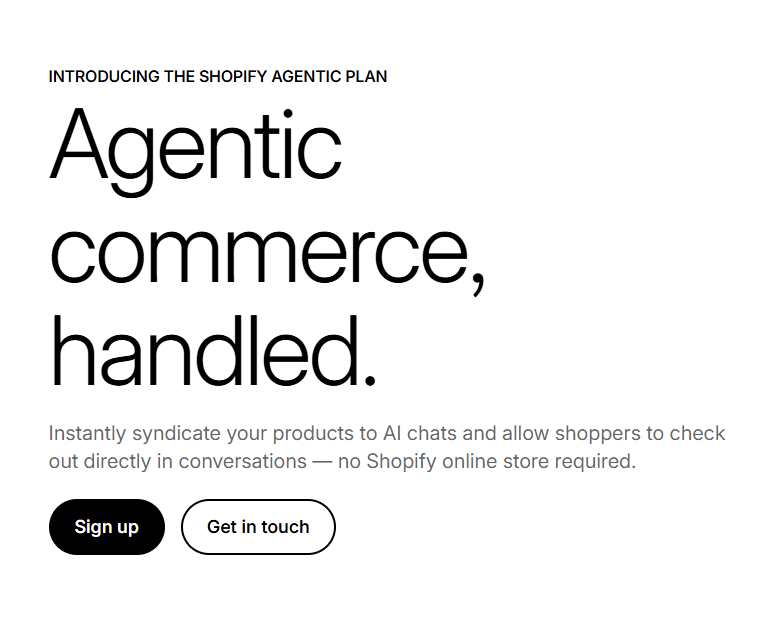
This shift marks the beginning of agentic commerce and it fundamentally changes how Shopify stores are discovered, evaluated, and chosen.
From Search Engines to Decision Engines
Traditional eCommerce has been built around visibility in search engines.
You compete for:
- Click-through rates
- Landing page conversions
But AI changes the interface.
Instead of showing multiple options, AI systems:
- Aggregate information
- Filter based on preferences
- Recommend a small set of products, often just one
This is a move from search engines to decision engines.
And it has a direct implication:
You are no longer competing for clicks. You are competing to be selected.
Why This Matters for Shopify Merchants
AI agents do not behave like human shoppers.
They prioritize:
- Structured product data
- Price competitiveness
- Availability and delivery speed
- Verified reviews and signals
They do not:
- “Browse” your homepage
- Appreciate brand storytelling in the same way
- Explore your collection pages
This creates a disconnect.
Most Shopify stores are optimized for human browsing.
But the next wave of commerce is optimized for machine interpretation.
The Rise of Zero-Click Commerce
One of the most important shifts is the rise of zero-click commerce.
In this model:
- Discovery happens inside AI
- Evaluation happens inside AI
- The decision is made inside AI
In many cases, the customer may never visit your website at all.
This does not eliminate your Shopify store.
It redefines its role.
Your store becomes:
- A structured data source
- A transaction engine
- A fulfillment backend
Rather than the primary discovery channel.
The Strategic Risks
If left unaddressed, this shift introduces several risks:
1. Loss of Direct Customer Access
When AI becomes the interface, you lose visibility into how customers discover and evaluate your products.
2. Weakening Brand Differentiation
AI agents prioritize utility. This can compress differentiation and push competition toward price and logistics.
3. Dependency on AI Platforms
Traffic shifts from owned channels to AI ecosystems, increasing reliance on third-party platforms.
The Hidden Opportunity
Despite the risks, early data suggests that AI-driven traffic is:
- Higher intent
- More engaged
- Further down the funnel
This means Shopify merchants who adapt correctly may see:
Fewer visitors, but higher-quality buyers.
The opportunity is not in maximizing traffic.
It is in maximizing inclusion in AI recommendations.
The Shift from SEO to GXO
Search Engine Optimization is evolving into something broader.
Generative Experience Optimization (GXO) focuses on how your brand and products are represented in AI-generated answers.
This requires a different approach:
- Content must be factual, structured, and machine-readable
- Product data must be consistent and enriched
- Brand presence must extend beyond your own website
AI systems pull from:
- Product feeds
- Reviews
- Forums
- Video platforms
- Knowledge bases
Your visibility is now distributed across the entire digital ecosystem.
What Shopify Merchants Should Do Now
1. Structure Your Product Data for Machines
Ensure:
- Clear product titles
- Standardized attributes
- Consistent categorization
- Accurate pricing and inventory
This is foundational. Without it, you are invisible.
2. Expand Beyond Your Storefront
Invest in:
- Reviews
- UGC
- Community discussions
- Content across platforms
AI systems rely heavily on external signals.
3. Build AI-Readable Content
Focus on:
- FAQs
- Comparison content
- Clear benefit-driven descriptions
Avoid vague branding language. Prioritize clarity.
4. Rethink Your Funnel
Old model:
Awareness → Consideration → Conversion
New model:
AI recommendation → Immediate purchase
Your role shifts from guiding a journey to being the chosen outcome.
Conclusion
Agentic commerce is not a future trend.
It is already reshaping how consumers discover and buy products.
For Shopify merchants, the implication is clear:
Success will no longer depend solely on how well you attract traffic.
It will depend on how effectively you position your products to be selected by AI systems.
The brands that adapt early will not just survive this shift.
They will define it.


