

Avoid Chargebacks: Shopify Return Policy for Singapore Stores
Publish a policy that states your return window, eligible and ineligible items, condition requirements, resolution options, shipping costs, process steps and expected timeline, then go into your Shopify admin and enable self-serve returns with return rules configured to match. Link your customer accounts URL directly from the policy page. If you sell in markets without a blanket change-of-mind right, say so plainly rather than implying one.
TL;DR:
- Ensuring your return policy accurately states the start date, eligible items, condition requirements, and resolution options minimizes support tickets and disputes.
- Configuring your Shopify settings to match your written policy for return windows, shipping fees, and return rules is essential to provide a smooth customer experience.
- Enabling self-serve returns and linking directly to the customer accounts page significantly reduces manual follow-up and streamlines the process.
- Implementing checks like proof of purchase, condition categorization, and internal logs helps detect abuse and prepare evidence for chargebacks.
- Promoting your policy clearly across product pages, during checkout, and in confirmation emails increases customer understanding and trust.
Table of Contents
- Why a clear return policy matters for Shopify stores
- What to include: a practical policy checklist and how to phrase each item
- Shopify setup: enable return rules and self-serve returns (step-by-step)
- Preventing fraud while preserving customer experience
- Ready-to-use templates and brief examples to paste into your policy
- Automation and scaling: reduce work and keep control as returns rise
- Where to publish the policy and how to communicate it clearly
- Soodo’s experience: what we see and the quickest wins
- How Soodo can implement and optimise your Shopify returns process
- FAQ
- Sources
Why a clear return policy matters for Shopify stores
A return policy is not paperwork you publish to tick a box; understanding different e-commerce business models can help tailor your policy effectively. Shoppers read it before they buy, especially on higher-priced items or anything with a sizing risk, and a vague or hidden policy reads as a warning sign. Ambiguity is also where disputes start: when a customer and your support team disagree about what “like new” means or when a 30-day window actually begins, you end up negotiating case by case, which is slow and inconsistent.
A well-written policy pays off in three ways:
- It gives shoppers the confidence to complete checkout, particularly for first-time buyers unfamiliar with your brand.
- It reduces chargebacks and drawn-out support threads by setting expectations before a dispute arises.
- It makes returns predictable to staff, so decisions are consistent and you can track return rates by product instead of firefighting one ticket at a time.
Stores with specific, itemised policies spend far less time on back-and-forth emails than stores running a generic, copy-pasted paragraph.
What to include: a practical policy checklist and how to phrase each item
Every clause in your policy should answer a question a customer would otherwise email you about. Vague language creates more tickets, not fewer.
- Return window: state whether it starts from delivery date, order date or shipping confirmation, and say so explicitly: “Returns must be requested within 30 days of delivery.”
- Eligible vs ineligible items: list categories by name (electronics, underwear, personalised items, gift cards) rather than relying on a general “final sale” clause that invites argument.
- Condition requirements: specify tags attached, original packaging, unworn or unused, and whether proof of purchase (order number or receipt) is required.
- Resolution options: say clearly whether customers get a refund to the original payment method, store credit or an exchange, and note any restrictions on mixing these.
- Shipping and fees: state who pays return shipping and whether a restocking fee applies, and to what percentage or flat amount.
- Processing timeline: give a realistic window from the moment you receive the item to when a refund appears, distinct from how long the bank takes to post it.
- How to start a return: point customers to your self-serve returns portal or customer accounts page with a direct link, rather than asking them to email first.
| Policy element | What to specify | Common mistake |
|---|---|---|
| Return window | Start date and duration | Leaving the start date unstated |
| Eligible items | Named categories, with exceptions | One vague “final sale” line |
| Condition | Tags, packaging, proof of purchase | No mention of condition at all |
| Resolution | Refund, credit or exchange | Implying all three always apply |
| Shipping and fees | Who pays, any restocking fee | Fee mentioned nowhere until a dispute |
| Timeline | Days from receipt to refund | Confusing bank posting time with processing time |
Shopify’s own return policy template is a reasonable starting point, but it needs editing to reflect your actual rules rather than being published as-is. A template that does not match your configured settings in admin creates the exact ambiguity this checklist is meant to remove.
Shopify setup: enable return rules and self-serve returns (step-by-step)
Writing the policy text is only half the job. If your Shopify admin settings do not match what you have written, customers will hit a wall when they try to act on it.
- Go to Settings > Policies in your Shopify admin and find the return and refund policy field, where Shopify can generate a starting template for you to edit.
- Go to Settings > Customer accounts and enable customer accounts if they are not already active, since self-serve returns depend on customers being able to log in and view past orders.
- Navigate to the fulfilment or returns settings to configure return rules: set your return window in days, whether return shipping is paid by you or the customer, and any restocking fee.
- Turn on self-serve returns so customers can request a return or cancellation directly from their order page instead of emailing support.
- Copy the customer accounts URL and paste it into your written policy so the “how to start a return” section links straight to the self-serve flow.
- Check your return rules against your written text line by line. Generating a policy template does not automatically wire up the logic behind it, so a mismatch here is one of the most common support headaches we see.
- If you ship internationally, note that Shopify-created return shipping labels are only available when both your primary location and the customer’s address are in the United States, so plan an alternative process for other regions.
Once rules and text agree, self-serve returns meaningfully cut down on manual back-and-forth, because customers see their eligibility and estimated refund automatically rather than waiting on a reply.
Preventing fraud while preserving customer experience
Returns abuse takes a few predictable shapes: customers who claim an item arrived damaged with no evidence, “wardrobing” where a product is used once and returned, and repeat returners who order multiples of the same item expecting to keep only one. None of these require you to treat every customer as a suspect, but they do require policy language and internal checks that make abuse harder.
Practical controls worth building in:
- Require proof of purchase (order number is usually enough) before processing any return.
- Write condition requirements specifically: “items must be unworn, unwashed, with tags attached” rather than a vague “in resalable condition.”
- Apply a restocking fee or final-sale tag to categorize prone to abuse, such as worn apparel returns or opened electronics.
- Keep a simple internal log of repeat returners by email or shipping address so patterns are visible rather than anecdotal.
When a dispute escalates to a chargeback, you will need evidence: delivery confirmation, condition photos taken on return, and correspondence showing the customer agreed to your stated terms. Shopify itself does not provide a built-in historical audit comparing returns against disputes, so a proper review means exporting payment dispute records and reconciling them manually against order history on a regular basis.
Pro Tip: Keep your fraud-prevention language firm but neutral, for example “returns showing signs of wear outside normal inspection may be declined,” rather than language that sounds accusatory before a case has even been reviewed.
Ready-to-use templates and brief examples to paste into your policy
You do not need to write this from scratch. Three short templates cover most standard situations, each ready to adapt with your own numbers.
Standard refund template: “We accept returns within [30] days of delivery. Items must be unused, with original tags and packaging. Once received and inspected, refunds are usually issued to your original payment method within a reasonable business processing time. A restocking fee may apply to specified categories as stated in the policy.”
Exchange-first template: “We offer free exchanges within a standard return window for a different size or colour. If your preferred option is unavailable, we will issue store credit. Return shipping for exchanges may be covered by us; refund requests could be subject to a processing fee as detailed in the policy.”
Final-sale template: “Items marked Final Sale, including clearance and personalised products, are generally non-returnable or exchangeable unless defective. Defective items should be reported promptly with evidence for replacement or refund.”
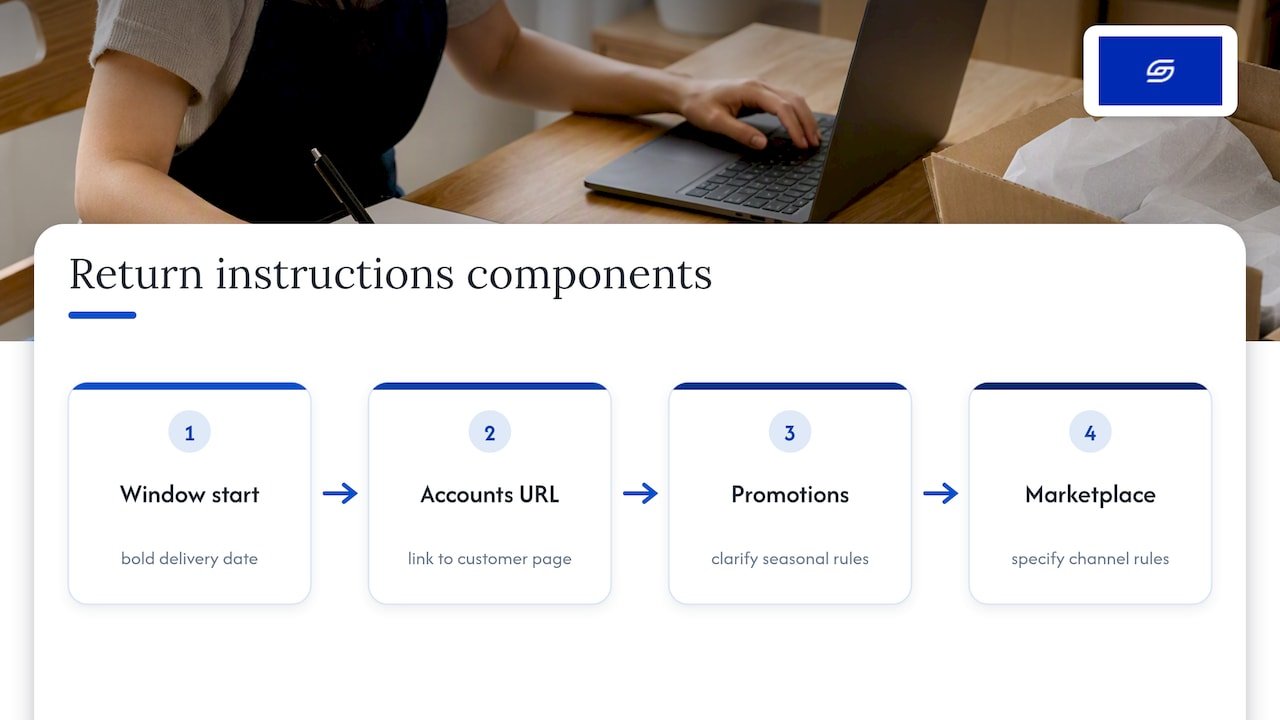
A few microcopy habits make these easier to scan: lead each clause with a bullet rather than a dense paragraph, put the return window start date in bold so it cannot be missed, and always link your customer accounts URL in the “how to return” section rather than only naming an email address. If you run seasonal promotions or sell through a marketplace channel, add a short note clarifying whether the same window and fees apply, since customers often assume promotional or marketplace purchases follow different rules.
Automation and scaling: reduce work and keep control as returns rise
As order volume grows, manually approving every return stops being realistic. Shopify’s return rules exist precisely to automate the repetitive part of this decision.
- Configure return rules so eligibility, return windows and any restocking fee are checked automatically rather than by a person reading each request.
- Set up automated email notifications for each stage of the return lifecycle: request received, approved, item received, refund issued.
- Use rule-based approvals for low-risk returns (within window, no flags) and route anything outside the rules to manual review.
- Once volume or complexity outgrows native Shopify tools, a dedicated returns management app can add features such as bulk label generation or more granular approval workflows.
Beyond day-to-day automation, track a short list of metrics monthly: return rate by SKU, which flags sizing or quality problems early; the share of returns coming from repeat customers, which flags potential abuse; and your dispute-to-order ratio, which tells you whether your written policy and your admin settings are actually aligned. A rising dispute ratio despite a published policy usually means the two have drifted apart.
Where to publish the policy and how to communicate it clearly
A policy nobody reads before checkout does not do its job. Place a short return-window summary on product pages, a reminder in the cart before checkout, a link in the footer of every page, and the full policy on its own dedicated page.
- Add a simple badge near the price, such as “30-day returns”, so shoppers see the window without hunting for it.
- Link the customer accounts URL from the returns page itself, so the written policy and the self-serve action sit side by side.
- Write out the actual steps: log in, select the order, choose the item, pick a reason, print or request a label.
- Send a short confirmation email at each stage of the return, since silence between “request submitted” and “refund issued” is what generates most follow-up tickets.
Merchants who treat the returns page as part of the shopping experience, not an afterthought buried in the footer, tend to see fewer pre-purchase questions and fewer abandoned carts from shoppers unsure what happens if an item does not fit.
Soodo’s experience: what we see and the quickest wins
Across the Shopify stores we have worked on, the same three mistakes show up repeatedly: return rules configured in admin that do not match the written policy, a return window with no clear start date, and a “contact us” instruction with no link to the self-serve returns portal. Each one generates support tickets that a five-minute settings fix would prevent.
The quickest wins are the ones already covered above: set your return rules first, write short bulleted clauses rather than dense paragraphs, enable self-serve returns, and review disputes monthly rather than only when volume spikes. Our Shopify optimisation checklist covers these alongside other admin settings worth auditing.
— Soodo
How Soodo can implement and optimise your Shopify returns process
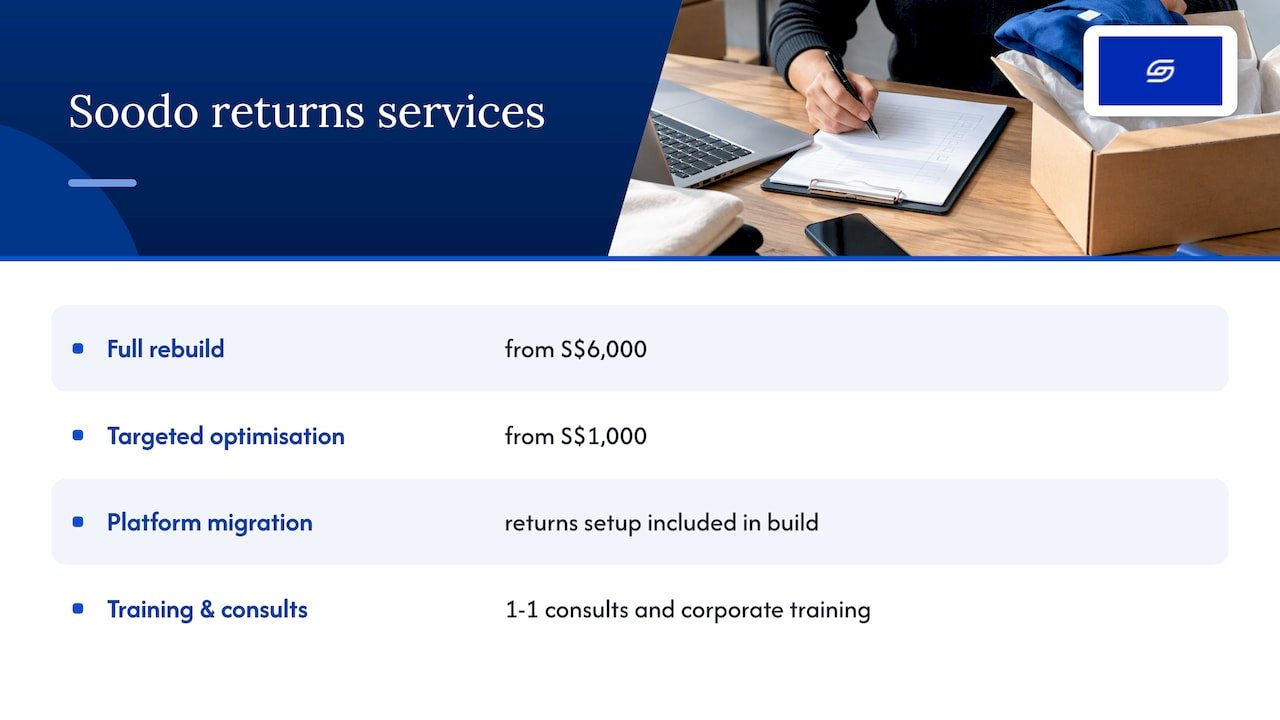
Getting the written policy and the admin configuration to actually match is exactly the kind of detail work we do on existing store optimisation projects, starting from 6,000 Singapore dollars for a full rebuild or from 1,000 Singapore dollars for a targeted optimisation engagement.
We set return rules, link customer accounts correctly, and rewrite policy copy so it reads clearly without opening the door to abuse, work we have done across many Shopify store consultations. If you are migrating from another platform, our platform migration service folds returns setup into the build rather than leaving it for later. For teams that want to understand the settings themselves, we also run 1-1 consults and corporate training on exactly this kind of Shopify admin work.
Get in touch to have your returns flow reviewed and configured properly.
FAQ
What is Shopify’s refund policy?
Shopify does not impose a single refund policy on merchants; instead, it gives you the admin tools, including return rules and the Policies settings, to write and enforce your own. Refunds you approve through Shopify are returned to the customer’s original payment method or issued as store credit, and once issued, they cannot be reversed.
What is the downside of using Shopify?
Shopify’s native tools have some regional limits worth knowing before you promise more than you can deliver. For example, Shopify-created return shipping labels are only available when both your store’s primary location and the customer’s address are in the United States, so international returns need a separate process.
What is a refund and return policy?
A refund and return policy is the published document telling customers how long they have to return an item, which items qualify, what condition is required, and what resolution (refund, credit or exchange) they can expect. On Shopify, this written policy should match the return rules configured in your admin, since the two are meant to work together rather than separately.
How long does it take for Shopify to refund you?
The timeline depends on the merchant’s own processing window, which should be stated in their policy, plus however long the customer’s bank takes to post the refund once issued. Where a purchase falls under Singapore’s Cancellation of Contracts Regulations 2009, suppliers must repay the consumer within 60 days of receiving a valid cancellation notice.
Sources
The rules and settings referenced throughout this guide come from Shopify’s own documentation and, for Singapore-specific cancellation rights, from government legislation. Checking these directly is worthwhile if you are drafting clauses that touch on legal obligations rather than just store settings, since platform features and regulations can be updated independently of each other.
- Consumer Protection (Fair Trading) (Cancellation of Contracts) Regulations 2009
- Shopify Help Center | Setting up self-serve returns and cancellations
Recommended

Jessica Bong
Jessica Bong is the founder of Soodo, a Singapore Shopify agency that builds, revamps and migrates Shopify stores, with every store set up to be found in AI search (GEO). She has spent over 10 years in ecommerce and runs her own Shopify brand, Patch&Bagel, where every Soodo technique is tested first. Jessica is also a WSQ-certified Shopify trainer at Equinet Academy.