


Shopify App Development Cost in Singapore: What to Budget
There is no single price for a Shopify app. The cost depends on what the app does, how many systems it connects to, and whether you need it built from scratch at all. This guide shows you how agencies and developers build a quote, what is usually left out of it, and how to decide before you spend.
We are Soodo, a founder-led Shopify agency in Singapore. We build, revamp and migrate Shopify stores for brands in Singapore and Southeast Asia, so we see the app question come up in almost every project.
Key Takeaways
- App cost is set by scope: features, integrations, who can use the app and how it must be hosted. Headcount and hourly rate matter less than a clear brief.
- Many store needs are met by an existing app or a theme change. Check this first, because it can remove the need for a custom build.
- Budget for the life of the app, not just the launch. One 2026 industry write-up suggests a further 50% to 100% of the build cost in year one.
- A good quote lists scope, exclusions, testing, handover and who owns the code.
- At Soodo, a new Shopify store starts from SGD 8,500, a Shopify Revamp from SGD 3,000 and a Migration to Shopify from SGD 6,000. Custom app work is scoped by application.
Table of Contents
- What does it cost to build a Shopify app in Singapore?
- What decides the price of a Shopify app?
- What should a Shopify app quote include?
- Do you need a custom app, or will an existing one do?
- What ongoing costs should you plan for?
- How do you prepare to get an accurate estimate?
- Where does the money usually go first: the store or the app?
- Our view: fix the store before you build an app
- How does Soodo price Shopify projects?
- Ready to scope your project?
- FAQ
- Sources
What does it cost to build a Shopify app in Singapore?
The honest answer is a range that depends on scope, and any figure quoted without seeing your brief is a guess. Prices you find online vary widely because they mix very different products: a small tool that adds one feature, a private app that links your store to your warehouse, and a full public app sold to other merchants.
A useful way to think about it is in three tiers of effort.
| Tier | What it usually looks like | What pushes the cost up |
|---|---|---|
| Simple | One clear job, such as a custom field, a small admin tool or a basic data sync | Extra screens, custom reports |
| Moderate | Several features, a merchant dashboard, one or two outside systems connected | Each integration, user roles, data volume |
| Complex | Many features, heavy data processing, billing, or an app listed for other merchants | Security reviews, scale, support load, ongoing updates |
We do not publish a price for custom app development, because we would be inventing a number. What we can tell you is how the quote is built, so you can judge any figure you are given.
What decides the price of a Shopify app?
Five things move the price more than anything else. Get these clear and your quotes will be far closer to each other.
1. Features and screens
Every feature needs design, build and testing. A list of ten features is not ten times a list of one, because features interact. Rank them as must have, should have and later. The must-have list is your first build.
2. Integrations
Connecting to an accounting tool, a courier, a warehouse system or a loyalty platform is often the largest cost. Each outside system has its own rules, limits and failure modes. Tell your developer the exact names of the systems and what data must move, and in which direction.
3. Who uses the app
An app only your team uses is simpler than one many merchants install. The second needs sign-up flows, billing, support and a review process. If you are building for your own store, say so clearly.
4. Design and user experience
An internal tool can be plain. A customer-facing feature on your storefront must look right on mobile, load quickly and match your brand. Most shoppers in Singapore browse on their phones, so mobile design is part of the build, not an extra.
5. Team and pricing model
A senior developer costs more per hour but often needs fewer hours. A fixed price gives you certainty if the scope is written down. Hourly billing suits work that is hard to define, but needs a cap. Either way, ask who actually writes the code.
What should a Shopify app quote include?
A reliable quote spells out what you get, what you do not, and what happens when something changes. Use this list when you compare proposals.
- Scope document: features in plain words, with a clear definition of done.
- Exclusions: what is not covered, such as content entry, data cleaning or third-party fees.
- Design and testing: whether these are included and on which devices and browsers.
- Integration work: one line per connected system.
- Handover: training for your team and documentation.
- Fixes after launch: how long bugs are fixed for, and at whose cost.
- Ownership: you should own the code and the accounts it runs in.
- Change process: how extra requests are priced.
Things often charged separately: hosting, third-party software subscriptions, paid APIs, stock photography, copywriting and any migration of existing data. Ask for each to be listed, even if the amount is zero.
Do you need a custom app, or will an existing one do?
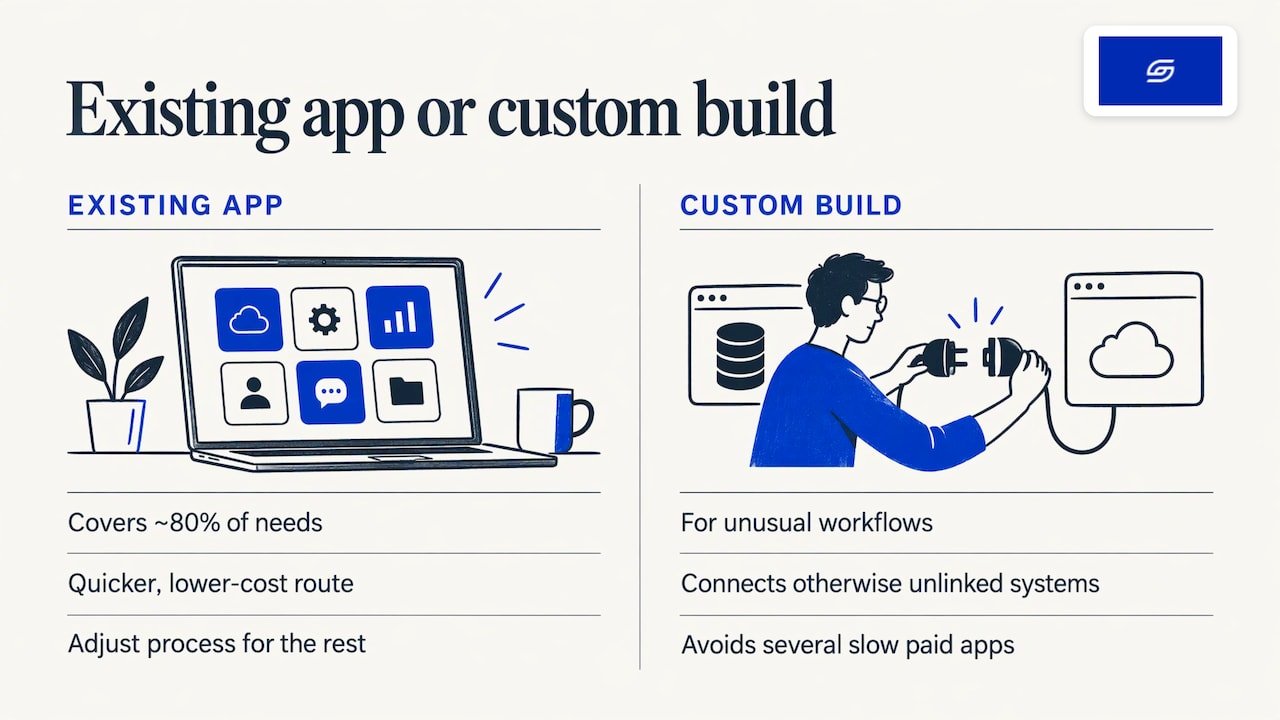
Start with an existing app. If one covers around 80% of what you need, it is usually the quicker and lower-cost route, and you can still adjust your process around the rest. A custom build earns its place when your workflow is unusual, when you need to connect systems that off-the-shelf apps do not link, or when you would otherwise stack several paid apps that slow your store.
We wrote a separate guide on choosing Shopify apps that pay back in Singapore. It covers how to judge an app by return rather than by feature list.
A simple test helps. Write down the task in one sentence. If you can name an app that does it, trial that first. If the sentence needs the word “and” three times, you may be describing a custom build.
Also consider whether the need is really about your store design. Many requests that begin as “we need an app” are solved by a better theme setup, a cleaner product page or a smarter checkout flow. That is store work, not app work, and it is often cheaper. Our guide on Shopify versus a custom ecommerce website explains where the line sits.
What ongoing costs should you plan for?
Plan for costs after launch, because an app is not finished when it goes live. Shopify updates its platform and its programming interfaces, and your app has to keep up.
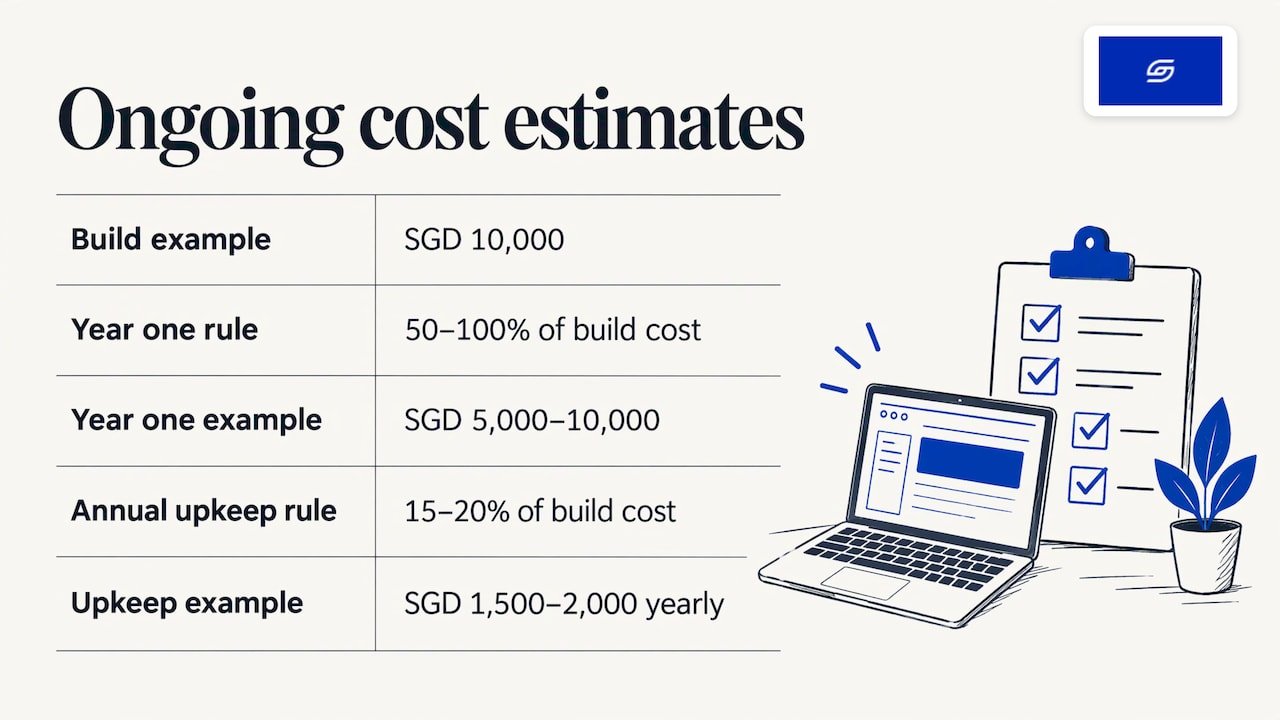
One 2026 industry write-up suggests budgeting another 50% to 100% of the build cost in year one for ongoing costs, then around 15% to 20% of the original build cost each year for upkeep such as security patches and compatibility fixes. Treat this as a rule of thumb from one source, not a Singapore price. It is still a useful reason to ask every developer what happens in year two.
Here is a worked example with made-up round numbers, only to show the arithmetic. If a build were priced at 10,000, year one ongoing costs at 50% to 100% would be 5,000 to 10,000. After that, 15% to 20% a year would be 1,500 to 2,000. Your own figures will differ, so ask for yours in writing.
Also budget your own time. Someone on your team must test, give feedback and make decisions. Delays in feedback are one of the most common reasons a project overruns.
How do you prepare to get an accurate estimate?
The more you can show, the tighter the estimate. Bring this to your first call:
- The problem: what slows you down or loses sales today.
- The users: your team, your customers, or other merchants.
- The systems: names of every tool the app must talk to.
- The data: what moves, how often, and how much.
- Examples: screenshots of similar tools you like.
- Budget range: a number, even a rough one. It helps a developer suggest the right size of build.
- Priorities: your must-have list, in order.
Then ask two developers or agencies to quote on the same brief. If the numbers differ a lot, the gap is usually in what each assumed was included. Our comparison of a Shopify agency and a freelancer in Singapore can help you decide who to ask.
Where does the money usually go first: the store or the app?
For most brands, the store comes first. An app improves a store that already converts. If your product pages, navigation or checkout are weak, an app will not fix that.
This is why we start with the store. Our approach is sales-first: every page, menu and app is built around how customers actually buy. Every store we build is also set up for AI search, known as GEO. You can read what that means in our guide to GEO.
If you want a view of store costs rather than app costs, see our Shopify website development cost guide for Singapore. For Shopify’s own plan fees, our Shopify pricing guide sets them out for Singapore.
Our view: fix the store before you build an app
We meet many founders who arrive asking for a custom app. After a short conversation, about half of them need something simpler first: a clearer store, better product pages or a cleaner checkout.
We say this because we run our own ecommerce brand, Patch&Bagel, and we test every recommendation there before we suggest it to a client. When we add something to a store, we ask one question: does it help a customer buy?
Soodo was founded in 2022 by Jessica Bong, who has 10+ years in ecommerce and is a WSQ Shopify trainer at Equinet Academy. We are a Shopify Partner with 30+ live stores. The founder leads strategy and a dedicated developer builds, so the person you brief is the person shaping the work.
That is why we take on a small number of projects each month, by application. When a custom piece of work is the right answer, we scope it as a custom one-time project with clear terms, handover training and 6 months of post-launch fixes. If something we built breaks, we fix it.
Soodo
How does Soodo price Shopify projects?
We price in fixed projects, not hourly guesses. Here are the three starting points we publish. These are the prices for store work, and they are not prices for custom apps.
| Project | Starting price | Best for |
|---|---|---|
| New Shopify store | From SGD 8,500 | Brands launching or rebuilding from zero |
| Shopify Revamp | From SGD 3,000 | Stores that work but need a stronger design and flow |
| Migration to Shopify | From SGD 6,000 | Brands moving from WooCommerce or another platform |
No GST is added, because Soodo is not GST-registered. The timeline and start date are agreed before we begin. Projects start on set monthly start dates. A 50% non-refundable deposit secures your start date, and the balance is due on completion.
Every project includes:
- Handover training, so your team can run the store.
- 6 months of post-launch fixes.
- Unlimited revisions within the agreed scope.
If you are moving from WooCommerce, our WooCommerce to Shopify migration guide shows what moves across and what to prepare.
Ready to scope your project?
If you have a store plan, a revamp in mind or a custom need, tell us what you are trying to achieve. We review each application and reply with a clear scope and a fixed quote for the work.
You can apply for a project slot or look at our new Shopify store service first. We do not run monthly GEO or SEO services. For long-term GEO growth after launch, we work with specialist partners.
FAQ
How much does Shopify app development cost in Singapore?
It depends on scope, so no honest single number exists. Cost rises with the number of features, the systems the app connects to and whether other merchants will install it. Ask for a written scope and a fixed price tied to that scope.
Is a custom Shopify app cheaper than using one from the App Store?
Usually not at first. An existing app is normally quicker to set up and costs less to start. A custom build makes sense when your workflow is unusual or when several paid apps are slowing your store.
What costs come after the app is built?
Plan for fixes, platform updates and your own team’s time. One 2026 industry write-up suggests 50% to 100% of the build cost in year one. Treat it as a guide and ask your developer for a written figure.
What should I bring to get an accurate estimate?
Bring the problem, the users, the names of connected systems, the data involved and a budget range. Add screenshots of tools you like and a ranked list of must-have features. This lets a developer price the right size of build.
Can Soodo help with a custom Shopify project?
Yes, we take on custom one-time projects by application, alongside new stores, revamps and migrations. We agree the scope, timeline and start date before we begin. Every project includes handover training and 6 months of post-launch fixes.
Sources
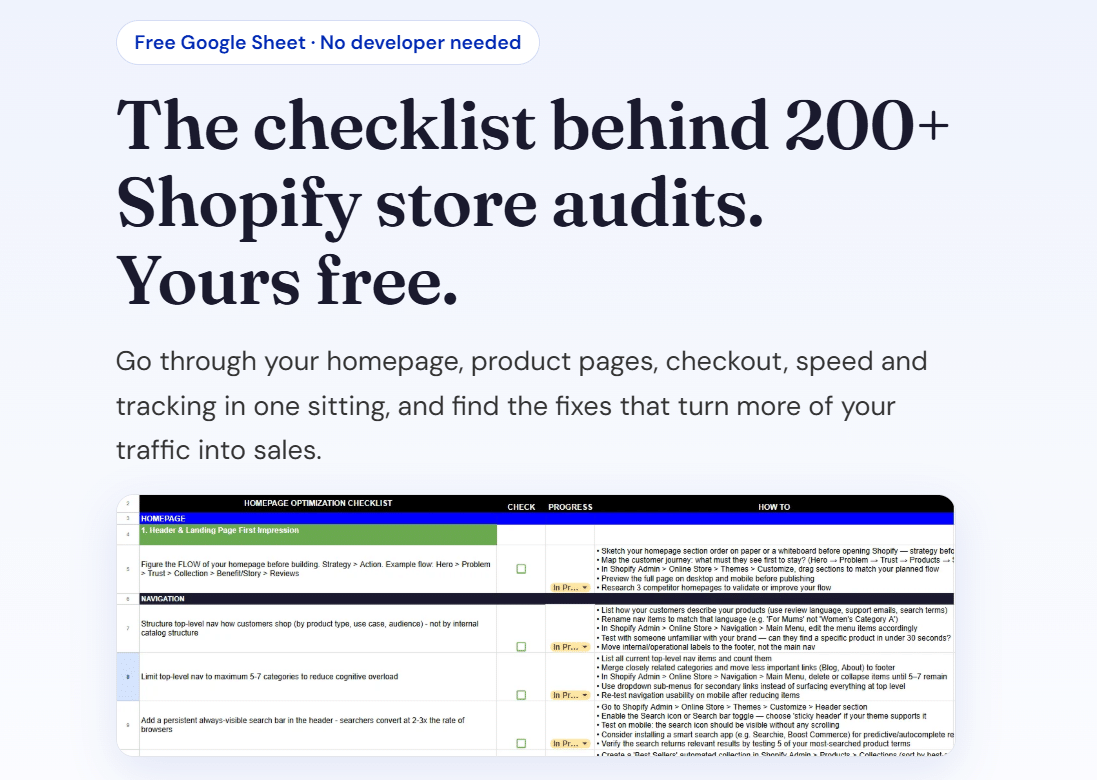
Next steps: get our free Shopify optimisation checklist or apply for a project slot.
Recommended

Jessica Bong
Jessica Bong is the founder of Soodo, a Singapore Shopify agency that builds, revamps and migrates Shopify stores, with every store set up to be found in AI search (GEO). She has spent over 10 years in ecommerce and runs her own Shopify brand, Patch&Bagel. Jessica is also a WSQ-certified Shopify trainer at Equinet Academy.